
Why sample work is not the same as daily production
Many businesses start with a few sample pieces for a boutique, school, church or local fashion label. That is a useful test, but sample work hides the real pressures of production. In a sample run, you can stop and adjust colours, pre-treat one garment at a time, and clean up slowly. In daily prinitng, you need the same result before lunch and after load-shedding, with less waste and no guesswork.
The first step is to treat samples as proof of demand, not proof of process. If a design sells well on three test garments, ask what happens when the order becomes 50 metres or 200 T-shirts. Can the print stay consistent? Can the operator repeat the same steps? Can the machine keep up without constant manual correction? Those are the questions that decide whether a side hustle can grow into a proper production line.
Start with a production plan, not just a machine
Before buying equipment, map the kind of work you want to do. A business in Germiston supplying fashion labels will have different needs from a printer serving event wear in Pretoria or souvenir work in Cape Town. Textile production is not only about speed. It is about matching the machine, heat press, inks and media to the product mix.
A practical plan should cover volume, fabric types, labour and space. If you work from a small unit in Wadeville or a backyard workshop in Boksburg, floor space and ventilation matter. If you are near the coast in Durban, humidity can affect storage and drying. If you rely on municipal power and back-up systems, you need to think about which steps must keep running during load-shedding and which can wait.
- List your top 3 products, such as T-shirts, panels or dress fabric.
- Estimate monthly volume in units or metres, not only in rand value.
- Check whether your work is mostly light cotton, blends or synthetic fabric.
- Measure your available space, power supply and drying area.
- Decide who will print, who will press, and who will check quality.
Colour control is what turns samples into repeat orders
When a customer approves a sample, they are really approving the colour, texture and finish. If the next batch shifts too far, the relationship becomes difficult fast. That is why colour profiling and a fixed workflow matter so much. A good profile helps you reproduce the same red, black or skin tone on the next run, even if the fabric batch changes slightly.
Small businesses often lose margin through reprints. One batch is too dull, another is too dark, and suddenly the job needs extra labour and extra ink. This is where support from a technician and a trained operator makes a difference. Keep a record of fabric type, heat press temperature, dwell time, humidity, ink set and the final result. It sounds basic, but it saves money.
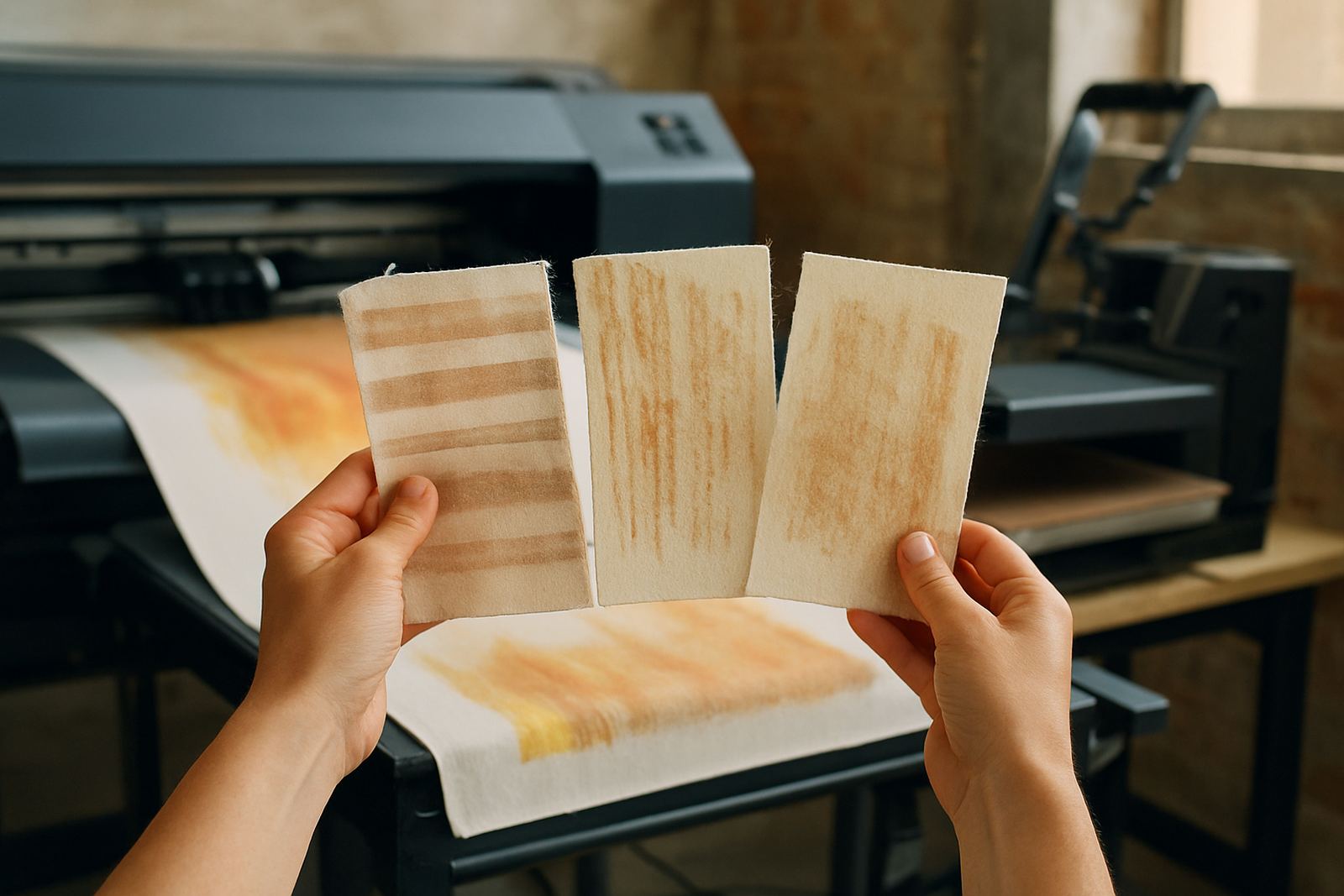
- Print a test strip before every new fabric batch.
- Keep one master sample from each approved job.
- Label fabric rolls by supplier, type and date received.
- Use the same temperature and press time for repeat work where possible.
Training the operator is as important as the printer
A reliable printer is only part of the system. The person using it has to know what a clean nozzle test looks like, when to flush the ink system, and how to spot a problem before it becomes a breakdown. For a business moving from samples to regular work, operator training should cover daily checks, simple fault finding and safe handling of inks and media.
Training also helps with consistency. A new operator might overheat a garment, rush a cleaning cycle or load fabric unevenly. Those mistakes cost time and can damage the job. In a small business, one trained person may handle printing, pressing and packing. That means the instructions have to be clear enough for another team member to step in when needed. It does not need to be fancy, just repeatable.
Plan for downtime before the first big order arrives
Once orders become regular, downtime becomes expensive. A printhead issue, blocked line or damaged part can stop a whole production run. That is why preventive servicing, printhead cleaning and ink system flushing should be part of the schedule, not only a reaction to a fault. In many South African workshops, the real challenge is not only the machine itself but the interruptions around it.
Load-shedding can interrupt a job mid-run, while coastal humidity can affect stored media and finished pieces. If you are based in Johannesburg, Pretoria, Durban, Cape Town or Bloemfontein, your support plan should reflect local conditions and turnaround times. Keep spare parts on hand for the items that fail most often, and set a maintenance contract if your business depends on weekly output.
- Do daily nozzle checks and a weekly cleaning routine.
- Store inks and media away from heat, dust and damp.
- Keep a backup plan for power cuts and unfinished jobs.
- Book servicing before the machine starts showing faults.
A local example: from sample run to steady textile work
Consider a small garment business in Germiston that begins with sample prints for a local fashion range. At first, the owner prints a few metre panels for approval, then presses finished garments one by one. The samples look good, but every order takes too long. After a few months, the business reviews its process, gets installation support, trains the operator properly and sets a fixed print routine.
Now the business can take repeat orders from retailers in Midrand and custom work from Pretoria without redoing the whole setup each time. The owner keeps a colour record, schedules servicing, and uses remote troubleshooting when a fault appears after hours. That shift from one-off testing to controlled production is what unlocks growth. The machine did not change the business on its own. The process did.
What to ask before you scale up
Before you move from samples to full production, ask a few direct questions. Will the current setup handle larger volumes? Do you have enough trained staff? Can your workspace cope with heat, storage and finishing? Are your clients ready for standard lead times and repeat colours? If the answer to any of these is no, solve that first.
For many South African textile businesses, the best next step is not buying more equipment straight away. It is tightening the workflow, keeping service support close, and building confidence in every stage from file prep to final press. When that is in place, growth becomes easier to measure and easier to control.