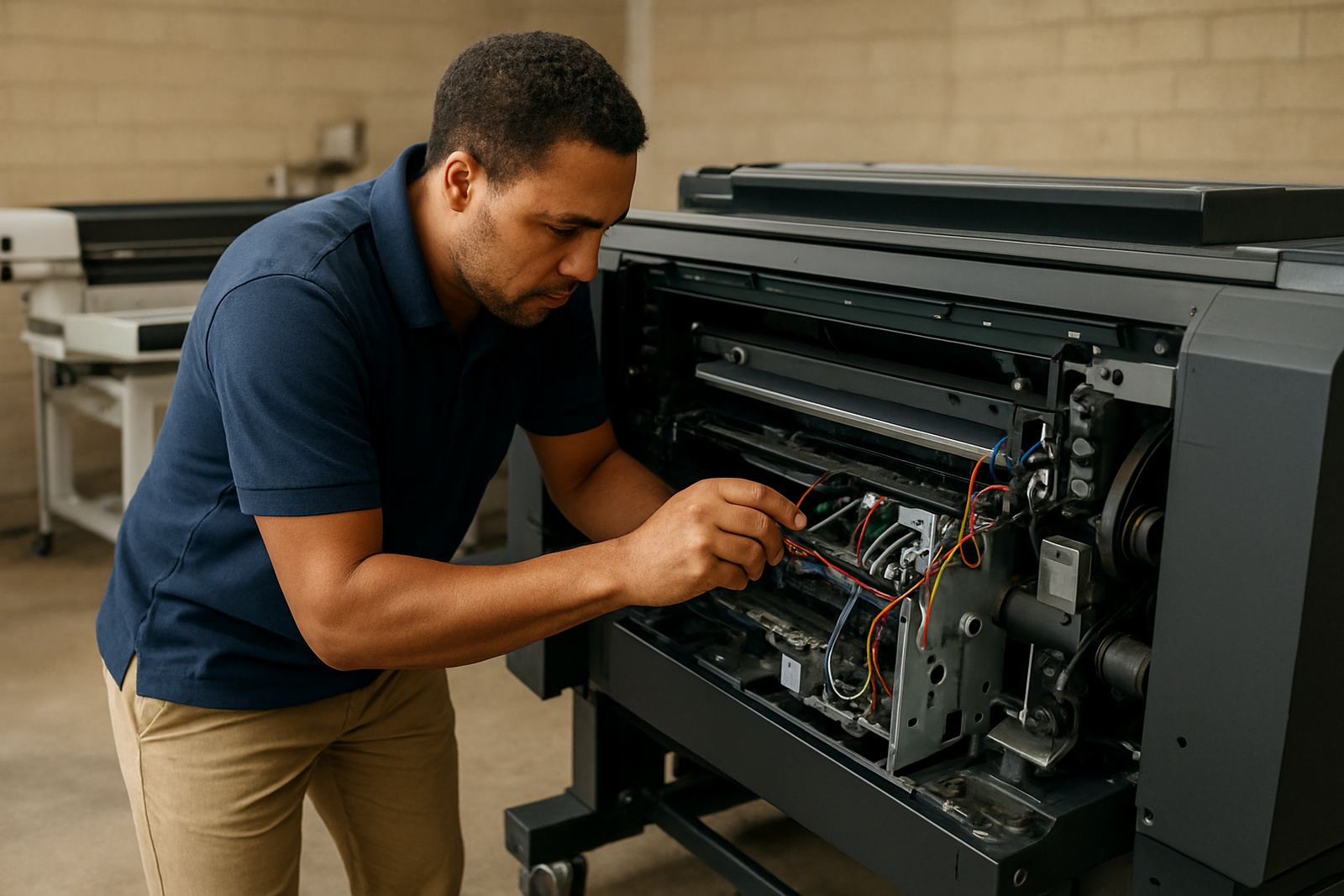
What Our Breakdown Repairs Cover
Our breakdown repair service is for direct-to-fabric inkjet printers, heat presses and connected ink systems used by small garment and textile businesses. We handle faults that stop production completely, plus issues that are still printing but causing waste, poor colour or inconsistent output. That includes head strikes, blocked nozzles, ink starvation, carriage faults, overheating, pressure problems on heat presses and electrical trips tied to the machine itself.
We support businesses in Germiston, Johannesburg, Pretoria, Durban, Cape Town, Bloemfontein and surrounding industrial areas where dust, humidity and power interruptions can affect print equipment. For coastal sites, we also look at corrosion, moisture in consumables and storage conditions that can shorten component life. If the problem is linked to operator setup, media handling or a previous service issue, we will point it out clearly so you can avoid repeat downtime.
How We Diagnose a Fault
Every breakdown starts with a proper fault check, not guesswork. We ask for the machine model, the symptoms, what changed before the fault and whether the unit was recently moved, cleaned or left idle during load-shedding. That helps us narrow down the cause before a technician is booked, which saves time on site and often shortens the repair cycle.
- Remote symptom review and basic checks through the enquiry form process
- On-site inspection of electrical, mechanical and ink delivery systems
- Nozzle checks, test prints and temperature readings where needed
- Error code review and confirmation of worn or failed parts
- Clear repair recommendation, including whether parts replacement is required
We keep the process practical. If the fault can be resolved by cleaning, flushing, a settings correction or a component reset, we will say so. If the problem points to a failing printhead, pump, heater element or control board, we will explain the repair path and the likely turnaround before work proceeds.
Repair Work Done On Site Or In Workshop
Many breakdowns can be handled on site, especially if the issue is related to blocked ink lines, misfeeds, alignment, press pressure or simple electrical faults. When the machine needs deeper work, we will advise workshop handling for safer strip-down, testing and part replacement. That is often the better choice for machines that have had repeated stoppages or have been running with poor maintenance intervals.
Typical breakdown repair work includes printhead cleaning, ink system flushing, hose checks, pump inspection, dampers, filters, heater checks and calibration after the fault is cleared. For heat presses, we inspect platen temperature, timer accuracy, pressure consistency and wiring points. If the machine has been relocated from one site to another, we also check levelling, vibration, cabling and any damage from transport.
- Direct-to-fabric printer fault repairs
- Heat press electrical and temperature faults
- Ink circulation, suction and clogging issues
- Calibration after repair so production quality can resume
Turnaround, Urgency And Production Priorities
Turnaround depends on the fault, the machine condition and whether spare parts are needed. Minor issues can often be handled the same day or within 24 to 48 hours in the Gauteng area, while more complex jobs may take longer if a specialised part has to be sourced. For out of town sites, response time depends on route planning and how urgently production is affected.
We understand that garment and textile businesses often work to order windows, school season rushes and retail deadlines. If a repair needs to be prioritised, tell us how much stock is pending and what your current print queue looks like. That helps us decide whether to send a technician immediately, schedule a remote first step, or plan a parts-led repair that reduces repeat visits. If the machine is still partially running, we will also tell you how to keep it stable until the repair is completed.
Pricing Approach And Parts Supply
Our pricing is based on the fault, the labour needed, the travel involved and whether replacement parts are required. We do not quote one flat amount for every breakdown because a clogged ink system is very different from a failed heater or a damaged printhead. You get a clear pricing approach once the fault is assessed, so you know what is being charged for and why.
Where possible, we use parts supply to keep the repair moving without delay. That may include pumps, dampers, filters, cables, heating components, sensors and other wear items commonly found in textile print systems. We also consider whether a repair is worthwhile compared with the age of the machine and its recent service history. If repeated failures are likely because maintenance has been missed, we will say so plainly rather than patching the same fault again.
Keeping Breakdowns From Coming Back
Most emergency repairs are avoidable with steady maintenance. For small businesses, we usually recommend preventive servicing every 3 to 6 months, depending on print volume, ink type and local conditions. In high dust areas or humid coastal areas, shorter intervals are often better. If your machine runs daily, or sits idle over weekends and then has to restart under pressure, regular checks become even more important.
During a maintenance interval, we look at print quality trends, worn consumables, electrical stability and any early signs that a fault is starting. That may include partial nozzle loss, slow circulation, rising temperature errors or repeated cleaning cycles. The aim is to catch a problem before it becomes a full shutdown. For businesses that print in shifts, we can also recommend a maintenance contract so support is easier to plan around production and load-shedding interruptions.
- Set cleaning and inspection intervals based on usage
- Track repeat faults before they stop the line
- Keep ink, media and spare parts stored correctly
- Plan downtime around production peaks and municipal power cuts
Key facts
| Supported equipment | Direct-to-fabric inkjet printers and heat presses |
|---|---|
| Common fault types | Clogging, head strikes, ink starvation, electrical faults, temperature errors |
| Service coverage | Germiston, Johannesburg, Pretoria, Durban, Cape Town, Bloemfontein and surrounding areas |
| Typical response | Same day to 48 hours in Gauteng, subject to fault and travel |
| Repair methods | On-site diagnosis, workshop repairs, cleaning, flushing, calibration |
| Maintenance interval | Every 3 to 6 months, depending on print load and site conditions |